
We took a quick trip to NW Georgia because Adam had to give a lecture at the Etowah Indian Mounds state park. Etowah is a pretty significant Native American site in Cartersville, GA that Adam has been conducting archaeological research about for his entire career. Today was Discover Etowah Day, held annually by the Friends of Etowah Society, and they had a few guest speakers; Adam was one of them. It was kinda sad being there knowing that the Georgia legislature had budget problems and cut the funding for this site and as of the 15th of this month dedicated state park employees are being laid off. This not only puts these poor people out of a job but it reduces the days the museum and site will stay open and encourages long periods of time that the park will be unattended. The site is a HUGE place, with 3 HUGE important mounds on it. This creates a very worrisome problem because Etowah is a sacred site to the Muskogee Creek Nation and important in Georgia's history as well as the history of the United States. Sites that are unattended tend to have thieves (looters) destroying them. I am heartbroken for this turn of events.
I hope that private groups may perhaps come together to save Etowah or that the National Park Service steps in and takes over Etowah as a National park, which, in my opinion, it should be anyway. For more information on Etowah you can visit the site here. You can also read more about Etowah from Adam's books found on Amazon: here and here. Of course you can google it too. I also have to brag that Adam and the Etowah site were written about and published in Archaeology magazine a few months ago, see here.
Last April, in 2008, a wattle and daub house was built at Etowah recreating a structure that was excavated several years ago near the site of the 2nd largest mound, Mound B. The "house" was rectangular, constructed of wooden posts around the perimeter and a few supports in the middle and a thatched roof. Cane was woven in between the posts for the walls. Dried clay mud mixed with grass was used to seal the inner and outer walls of the house, this is where the names wattle and daub come from. The wattle is the cane of the structure and the daub is the dried clay mud attached to it.
Please take a minute to read more about the house construction here. Its amazing to see the work that went into it, and the detail and all of the volunteers from around the southeastern US and especially from the local community that came out and helped build this house.
Of course, I took some pictures of the kids in and in front of the reconstructed wattle and daub house today when we were at the park. I also snapped some of the artifacts that are housed inside the museum. (Funny faces from the bright, hot sunshine).

Sitting on a handmade cane bench:

Roof, with hole for smoke, from firepit on the ground below:

Artifacts in the museum:
huge conch shell, traded for from the coastal areas of the southeastern US.


These are the two "famous" Etowah stone statues that were excavated from a burial in Mound C, at Etowah.


Pieces of wattle and daub excavated from the site(left) and a black ceramic vessel (right).
I forgot to get pictures of the mounds today, I've actually taken a zillion over the past few years but here is one I took of Ayla that you can see the largest mound, Mound A, in the background. Mound A is 63 feet high! it was constructed of earth, basically DIRT! that was carried from the side of the site in baskets to where the mounds are. Its probably a good 1/4 mile from the pit where they took the dirt from and where the mounds are.
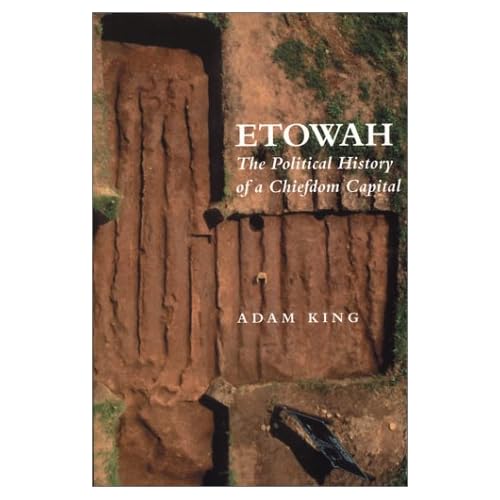
I just really love this site. It is beautiful, majestic, and it holds special meaning to us. Adam and I worked together on a project here in 1994 for a few weeks excavating the ground that was located under the old sets of stairs to Mounds A & B so that DNR could put in new staircases for the public. The old stairs were taken down and we did a few excavations. The coolest part and the part no one knew existed was a set of REAL stairs (steps) at the base of Mound A. The steps we found were made of clay and you can see them on the cover of the book that Adam wrote that I linked to above. Seen here:
This project lead to us dating, and the rest is history!


1 comments:
We are so saddened that Etowah will not be as attended to , as in the past.
It is a wonderfully unique and valuable Indian site. We hope to visit it again.
Jen and Adam, your devotion to this historic site is heartening. Your work has enlightened us all, to the rich and historic
place that is Etowah. Love Mom and Dad
Love Mom
Post a Comment